


Latest from Fauna Bio

Feb 18, 2021
American Heart Month: What Can Squirrels Teach Us About Survival?
2021
Read more
Feb 18, 2021
American Heart Month: What Can Squirrels Teach Us About Survival?
2021
Listen to podcast
Feb 18, 2021
American Heart Month: What Can Squirrels Teach Us About Survival?
2021
Watch video
American Heart Month: What Can Squirrels Teach Us About Survival?
2021
Read more
Watch Video
Feb 11, 2021
Fauna Bio is awarded an NIH small business technology transfer (STTR) grant
2021
Read more
Feb 11, 2021
Fauna Bio is awarded an NIH small business technology transfer (STTR) grant
2021
Listen to podcast
Feb 11, 2021
Fauna Bio is awarded an NIH small business technology transfer (STTR) grant
2021
Watch video
Fauna Bio is awarded an NIH small business technology transfer (STTR) grant
2021
Read more
Watch Video
Nov 11, 2020
Fauna Bio founder and CTO, Linda Goodman co-authors Nature article on comparative genomics for studying human disease and conservation
2020
Read more
Nov 11, 2020
Fauna Bio founder and CTO, Linda Goodman co-authors Nature article on comparative genomics for studying human disease and conservation
2020
Listen to podcast
Nov 11, 2020
Fauna Bio founder and CTO, Linda Goodman co-authors Nature article on comparative genomics for studying human disease and conservation
2020
Watch video
Fauna Bio founder and CTO, Linda Goodman co-authors Nature article on comparative genomics for studying human disease and conservation
2020
Read more
Watch Video
Nov 11, 2020
Advancing Comparative Genomics for Human Health: Fauna Bio Collaborates on study to compare 240 mammal genomes
2020
Read more
Nov 11, 2020
Advancing Comparative Genomics for Human Health: Fauna Bio Collaborates on study to compare 240 mammal genomes
2020
Listen to podcast
Nov 11, 2020
Advancing Comparative Genomics for Human Health: Fauna Bio Collaborates on study to compare 240 mammal genomes
2020
Watch video
Advancing Comparative Genomics for Human Health: Fauna Bio Collaborates on study to compare 240 mammal genomes
2020
Read more
Watch Video
Nov 2, 2020
Founder story: Ashley Zehnder
2020
Read more
Nov 2, 2020
Founder story: Ashley Zehnder
2020
Listen to podcast
Nov 2, 2020
Founder story: Ashley Zehnder
2020
Watch video
Founder story: Ashley Zehnder
2020
Read more
Watch Video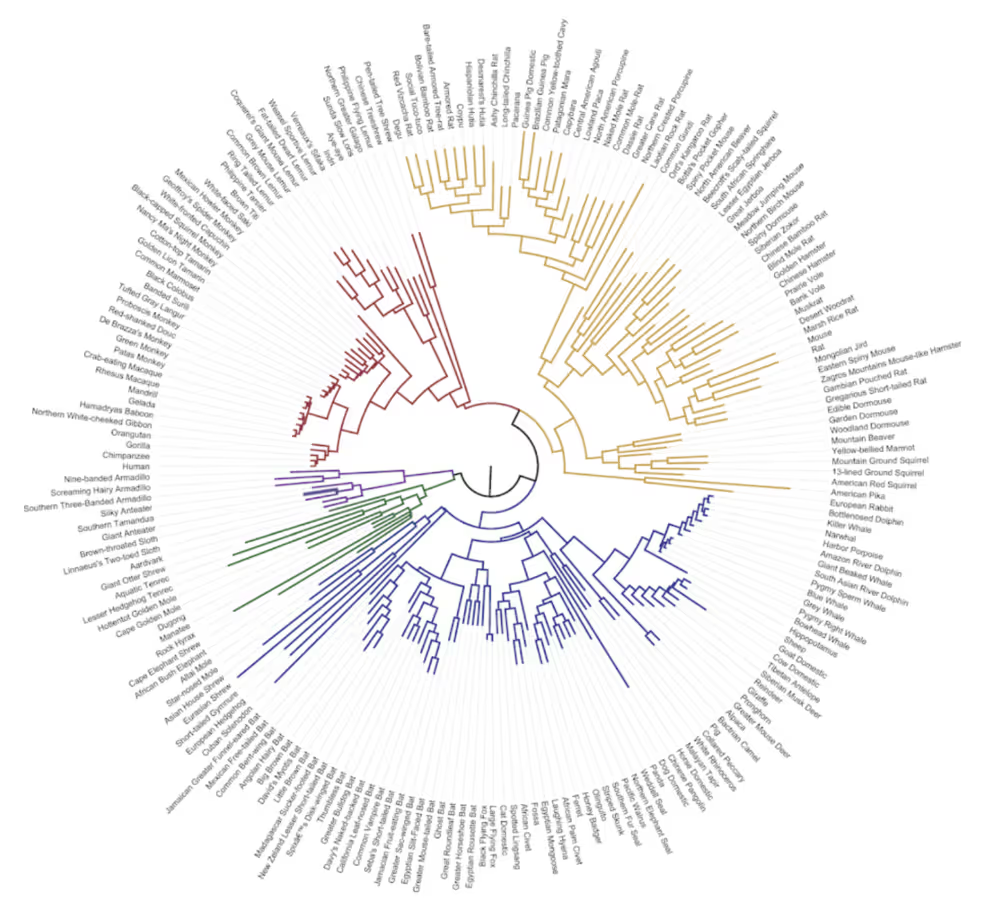
Jul 9, 2020
Founder story: Linda Goodman
2020
Read more
Jul 9, 2020
Founder story: Linda Goodman
2020
Listen to podcast
Jul 9, 2020
Founder story: Linda Goodman
2020
Watch video
Founder story: Linda Goodman
2020
Read more
Watch Video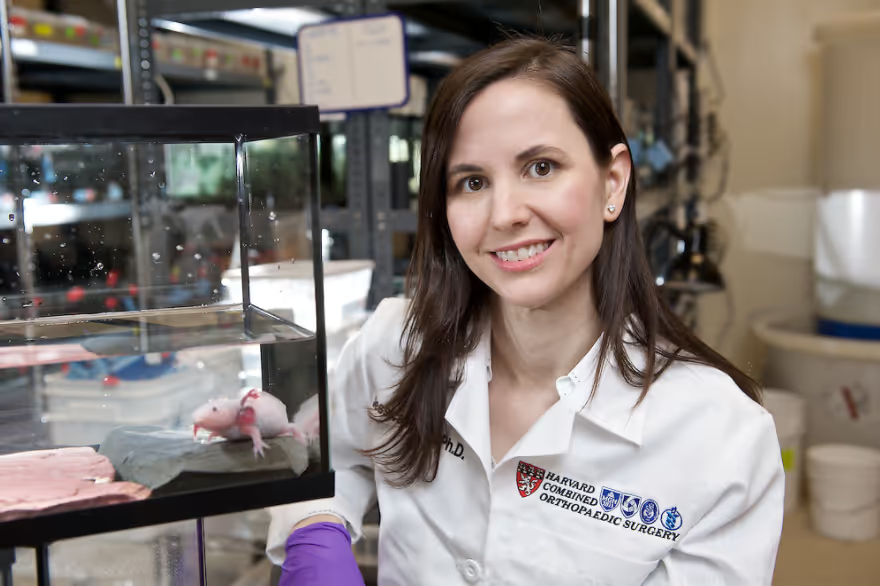
Jul 2, 2020
Lessons in Regeneration from Salamanders
2020
Read more
Jul 2, 2020
Lessons in Regeneration from Salamanders
2020
Listen to podcast
Jul 2, 2020
Lessons in Regeneration from Salamanders
2020
Watch video
Lessons in Regeneration from Salamanders
2020
Read more
Watch Video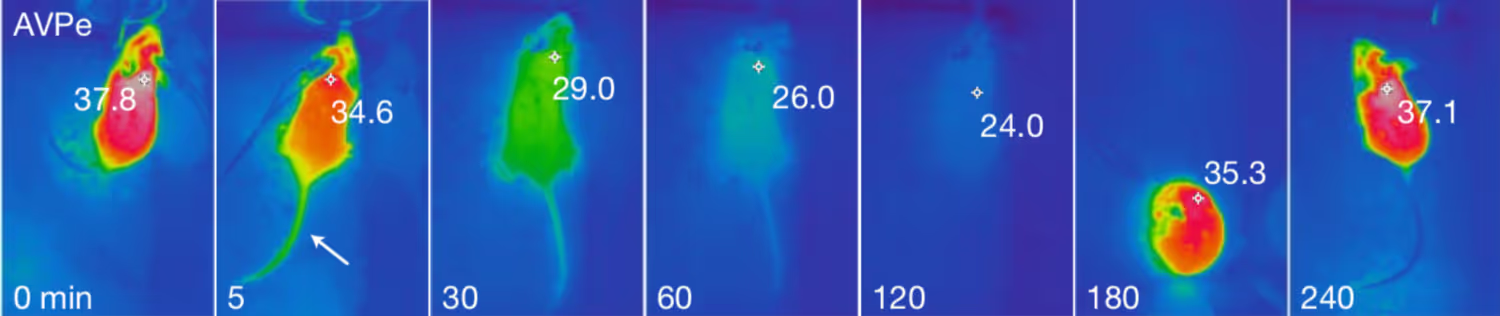
Jun 23, 2020
Have We Solved Hibernation? (A Perspective on Recent Advances in Understanding of Hibernation Induction)
2020
Read more
Jun 23, 2020
Have We Solved Hibernation? (A Perspective on Recent Advances in Understanding of Hibernation Induction)
2020
Listen to podcast
Jun 23, 2020
Have We Solved Hibernation? (A Perspective on Recent Advances in Understanding of Hibernation Induction)
2020
Watch video
Have We Solved Hibernation? (A Perspective on Recent Advances in Understanding of Hibernation Induction)
2020
Read more
Watch Video
May 5, 2020
Interconnected
2020
Read more
May 5, 2020
Interconnected
2020
Listen to podcast
May 5, 2020
Interconnected
2020
Watch video
Interconnected
2020
Read more
Watch Video
Apr 11, 2020
Fauna Bio CTO and Co-Founder, Linda Goodman, presents at the AWS Healthcare and Lifesciences Cloud Symposium
2020
Read more
Apr 11, 2020
Fauna Bio CTO and Co-Founder, Linda Goodman, presents at the AWS Healthcare and Lifesciences Cloud Symposium
2020
Listen to podcast
Apr 11, 2020
Fauna Bio CTO and Co-Founder, Linda Goodman, presents at the AWS Healthcare and Lifesciences Cloud Symposium
2020
Watch video
Fauna Bio CTO and Co-Founder, Linda Goodman, presents at the AWS Healthcare and Lifesciences Cloud Symposium
2020
Read more
Watch Video
Mar 30, 2020
Fauna Bio featured in Fortune AI Minute: “A.I. that helps discover human cures with animal genomics”
2020
Read more
Mar 30, 2020
Fauna Bio featured in Fortune AI Minute: “A.I. that helps discover human cures with animal genomics”
2020
Listen to podcast
Mar 30, 2020
Fauna Bio featured in Fortune AI Minute: “A.I. that helps discover human cures with animal genomics”
2020
Watch video
Fauna Bio featured in Fortune AI Minute: “A.I. that helps discover human cures with animal genomics”
2020
Read more
Watch Video
Mar 3, 2020
Fauna Bio CSO and Co-founder, Katie Grabek, honored as a TEDMED Hive participant.
2020
Read more
Mar 3, 2020
Fauna Bio CSO and Co-founder, Katie Grabek, honored as a TEDMED Hive participant.
2020
Listen to podcast
Mar 3, 2020
Fauna Bio CSO and Co-founder, Katie Grabek, honored as a TEDMED Hive participant.
2020
Watch video
Fauna Bio CSO and Co-founder, Katie Grabek, honored as a TEDMED Hive participant.
2020
Read more
Watch VideoNo results found.
Please try a different filter
Frequently Asked Questions
At the end of the day, humans are mammals. What Fauna is really doing is looking at ‘human’ genes that are helping these other species resist and reverse disease. We’re using extreme biology to look back at our own evolutionary history and find ‘the answer inside us’. We’re NOT putting squirrel genes into people!
Hibernators are particularly well suited for this approach because almost every major group of mammals has hibernators (including primates!). The gray mouse lemur in Madagascar hibernates pretty similarly to ground squirrels. This means they are tapping into core mammalian genetic pathways that are very similar across very different species. This is the reason that at Fauna Bio we even have T-shirts at Fauna that say “I’m 89% squirrel”!
To help us translate these insights into therapies for humans, we layer on many hundreds of different datasets from humans and then test our therapies in human disease models, to give us confidence that the same genes protecting ground squirrels from heart damage can protect humans in heart failure (as one example).
We are creating safer, more effective therapeutics for human diseases based on evolutionary adaptations to similar problems.
Our lead program, Faun1083, is a truly novel approach to a type of heart failure known as Heart Failure with preserved Ejection Fraction (HFpEF), which is about half (50%) of all heart failure cases around the world and is increasing as people get older and with obesity and metabolic disease. This is a drug that is entering the final set of safety studies (IND-enabling studies) that we need to be able to start clinical studies in humans.
This therapy came directly from learning how species like the 13-lined ground squirrel protect their hearts from damage that occurs during hibernation.
Yes! In two main ways:
- Because our custom knowledge graph, Centaur, now contains not only Fauna Bio data, but data from more than 35 large biomedical datasets with 1 million nodes, 38 million edges it is too large for any human to glean insights from it without the use of AI. Our graph neural network to analyze this knowledge graph has a billion model parameters!
- In order to enhance speed and scalability of drug discovery, we have specially trained AI agents (collectively called Fauna Brain) that can replicate the output of several days of effort by our team of highly trained drug hunters in a matter of minutes. This system is an excellent example of ‘human in the loop’ as our AI engineer worked directly with team members doing drug discovery with the ConvergenceAI platform to have Fauna Brain learn how to use the platform and improve its predictions. This is a living system that continues to learn and improve every time we use it for discovery.
Using extreme animal physiology enables Fauna Bio to do discovery from <100 samples vs. the more than >30,000 samples we’d need to try and get similar insights from human genomics (if we could even find signal at all…).
Our lead program, Faun1083, came from a study with just 60 samples from ground squirrels, almost 3 orders of magnitude less data than you’d need from human studies. This is because we are sampling tissues at the precise times when they are repairing themselves and it makes it much more obvious what genes are involved in that protection.
We still use all that human data, but to confirm findings from the ground squirrels as we can then look at humans that have natural mutations in genes we find with our approach and ask if we see correlations to diseases like heart failure. For our lead program, Faun1083, humans with mutations in the target of that program have links to changes in heart damage markers, changes in fuel utilized by the heart and changes relating to pulmonary hypertension, a common occurrence in patients with HFpEF.
Our internal innovations team has identified > 35 other species with disease resistance traits, in diseases like neurodegeneration, metabolic disease, chronic kidney disease and even aging. The amazing pipeline and partnerships we’ve been able to build have all been from 1 species, the remarkable 13-lined ground squirrel, but its just the tip of the iceberg!

